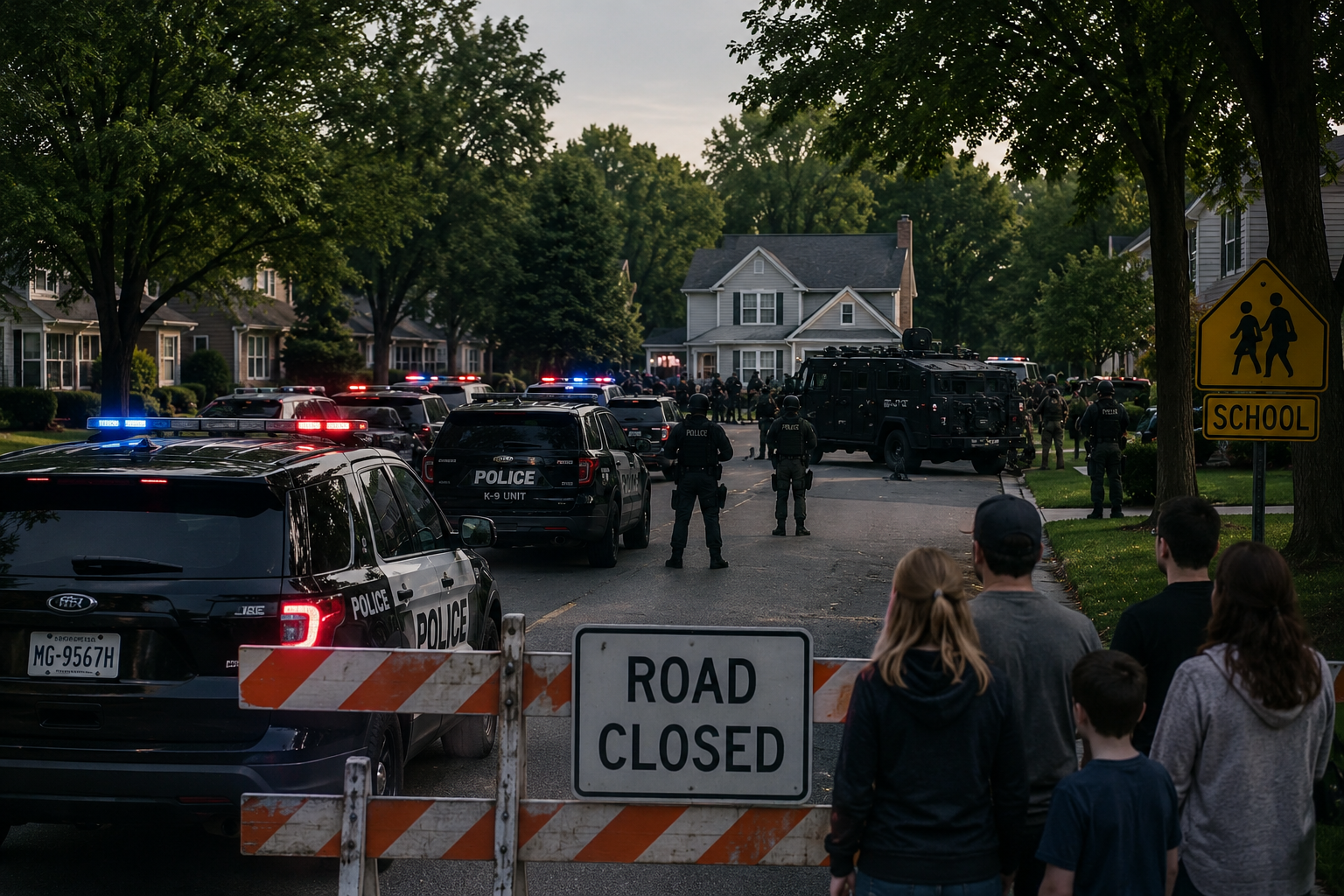
At first, most residents assumed there had been a traffic accident.
A patrol car had stopped sideways across the entrance to Willow Creek Drive, blocking both lanes.
Then another cruiser arrived.
And another.
Within minutes, officers were stretching yellow tape across the road and directing drivers away from the neighborhood.
People who lived inside the perimeter were told not to leave.
People trying to return home were told they could not enter.
Then phones throughout the neighborhood buzzed at almost the same time.
The emergency alert contained only a few lines.
Lock your doors. Stay inside. Stay away from the windows.
Nobody knew why.
Then the tactical officers arrived
That was when people realized this wasn't a routine police call.
A large armored vehicle rolled slowly onto the street.
Behind it came officers wearing helmets and heavy protective gear.
They moved quickly toward the far end of the neighborhood.
A police drone rose above the rooftops.
Another group of officers began positioning themselves behind parked vehicles.
From upstairs windows, residents could see that nearly all of the activity was focused on one house.
Number 48.
A modest two-story home with a blue front door, a basketball hoop over the garage and a children's bicycle lying near the driveway.
Nobody knew what was happening inside
The lack of information created a vacuum.
And rumors filled it almost immediately.
One neighbor texted that police were searching for an escaped prisoner.
Someone else claimed there had been a hostage situation.
Another person posted online that officers had found explosives.
None of those claims had been confirmed.
But within half an hour, screenshots of the rumors were circulating through neighborhood group chats.
Residents refreshed local news pages repeatedly.
Still, police said little.
One family was trapped on the wrong side of the barricade
Just outside the neighborhood entrance, Sarah Mitchell stood beside her car trying to convince an officer to let her through.
Her 12-year-old daughter was home with Sarah's mother.
The house was only three blocks away.
But the officer couldn't let her pass.
"They're safe where they are," he told her.
"Please call them and tell them to stay inside."
Sarah did.
Her daughter answered immediately.
She could hear police loudspeakers outside.
"Mom, what's happening?"
Sarah didn't know.
Then a negotiator spoke over a loudspeaker
Shortly after 3 p.m., residents closest to Number 48 heard a voice carrying across the street.
It came from a police loudspeaker.
The message was calm.
A man inside the house was being asked to come to the front door.
He was told to keep his hands visible.
The message repeated several times.
No one came out.
That's when residents realized officers were not simply searching the house.
Someone was still inside.
Police had been following him for hours
What residents didn't know was that the operation had begun long before the first cruiser appeared on Willow Creek Drive.
Earlier that afternoon, investigators had been searching for a man suspected in an armed robbery several miles away.
Detectives believed he had fled in a vehicle registered to a relative.
Traffic cameras eventually placed that vehicle near Willow Creek.
Officers found it parked behind Number 48.
They had reason to believe the suspect was inside.
But there was another problem.
Police believed other people were in the house too
The home belonged to the suspect's sister.
Investigators believed she and her two children may have been inside when he arrived.
That changed everything.
Officers could not simply rush through the door.
They had to consider the possibility that innocent people were only a few feet away from the person they were trying to arrest.
So the neighborhood remained sealed.
And negotiators kept talking.
Then the front door finally opened
At 4:36 p.m., after more than an hour of repeated instructions, movement appeared at Number 48.
The blue front door opened slowly.
A woman stepped outside.
Behind her came two children.
Officers immediately guided them behind an armored vehicle.
From inside neighboring homes, people watched silently.
For the first time that afternoon, residents understood why police had been so cautious.
There had been children inside.
But the operation still wasn't over
The man police wanted remained inside the house.
Negotiators continued speaking with him.
Another hour passed.
The neighborhood remained silent except for the occasional police radio and the low hum of the armored vehicle.
Residents were still being told to stay indoors.
Then, shortly before 6 p.m., the front door opened again.
The man walked out with his hands raised
This time a man stepped onto the porch.
He followed the officers' instructions.
He moved slowly toward the driveway.
Officers took him into custody.
No shots were fired.
No one inside the home was seriously injured.
And after hours of uncertainty, the threat police had spent the afternoon containing was finally over.
Residents finally learned why the barricades had been necessary
Police later explained that the neighborhood lockdown had been intended to keep residents away from a potentially dangerous arrest while negotiators worked to bring the people inside the house out safely.
Suddenly, the roadblocks, armored vehicle and repeated warnings made sense.
What had looked from the outside like an overwhelming police response had actually been designed to prevent the situation from becoming violent.
The rumors had been far more dramatic than the truth
There had been no bomb.
No neighborhood-wide attack.
No dangerous chemical leak.
But the uncertainty had made each rumor seem possible.
That afternoon showed exactly how easily fear can fill in the blanks when people don't yet know what's happening.
By nightfall, Willow Creek looked normal again
Police tape came down.
Patrol cars left one by one.
Residents stepped onto their porches.
Sarah finally drove back into the neighborhood and hugged her daughter in the driveway.
People who had spent hours communicating through text messages now stood outside talking face to face.
The street looked almost exactly as it had that morning.
But for the people who had watched tactical officers surround Number 48, the afternoon would not be forgotten quickly.
Sometimes the barricade tells only half the story
From behind a window, residents had seen armored vehicles, officers and police tape.
They had not seen the negotiations.
They had not known children were inside.
They had not known why officers were moving so slowly.
Once the full picture became clear, the hours of waiting looked very different.
What residents remembered most wasn't the moment the police arrived.
It was watching a woman and two children walk safely out the front door.
And later, watching the final person inside surrender without a shot being fired.
For one afternoon, Willow Creek had looked like a neighborhood under siege.
By evening, it was simply home again.