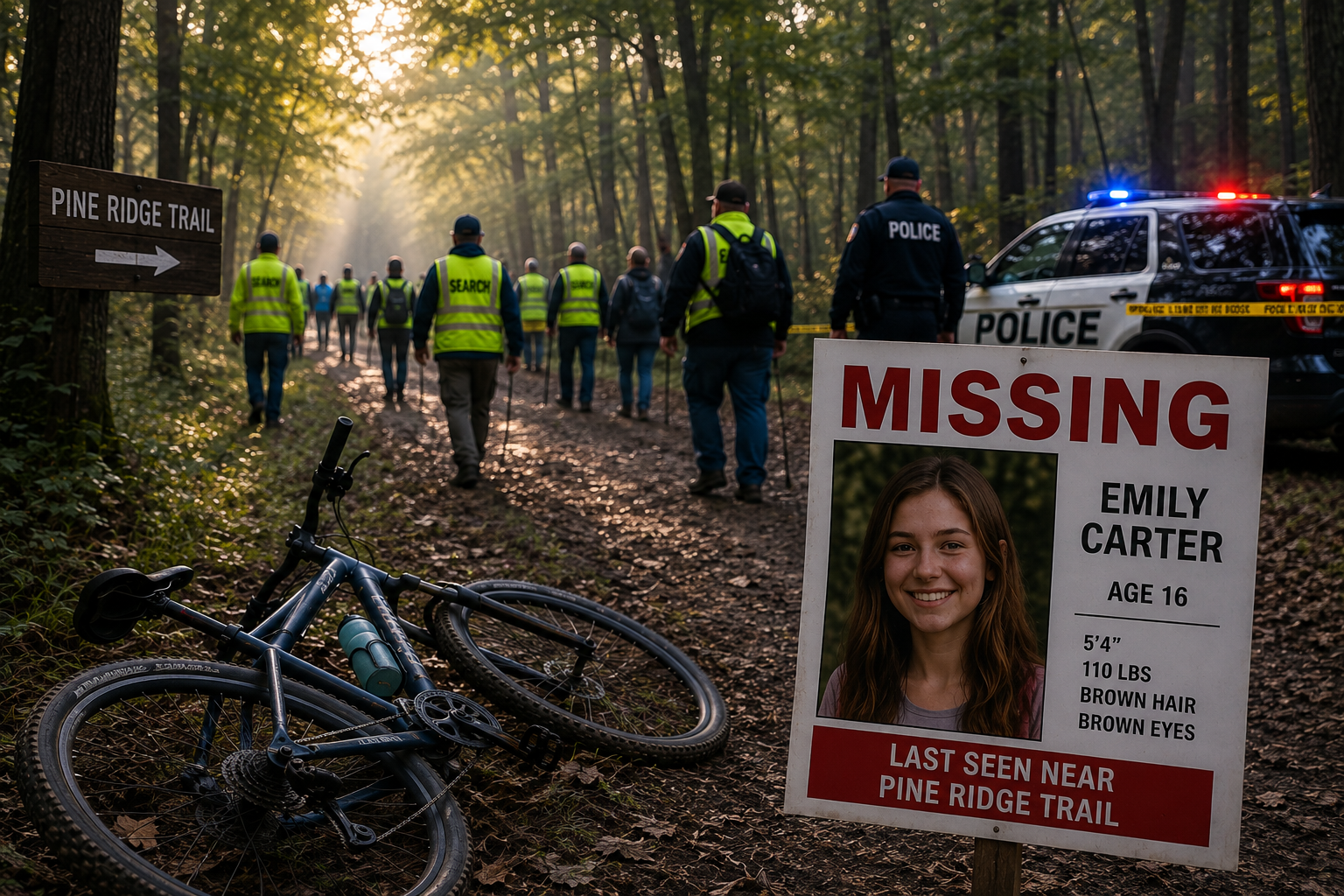
The first thing police found was Emily Carter's bicycle.
It was lying on its side near the entrance to a wooded trail about two miles from her home.
The front wheel was turned sharply toward the grass.
Her water bottle was still attached to the frame.
But Emily was nowhere nearby.
By midnight, nearly everyone in the small town of Bellwood had heard that the 16-year-old was missing.
By sunrise, volunteers were already gathering.
At first, everyone feared the worst
Emily's mother told police that her daughter had left the house shortly after dinner.
She said she was going for a bike ride.
It wasn't unusual.
Emily often rode along the wooded trail before sunset.
But that evening she never came home.
Her phone went straight to voicemail.
Her friends said they hadn't heard from her.
Police dogs were brought in.
Officers searched the trail.
Volunteers walked shoulder to shoulder through tall grass, drainage areas and nearby fields.
Flyers with Emily's photograph appeared in grocery stores, gas stations and restaurant windows.
Within two days, the search had become the only thing anyone in Bellwood was talking about.
Hundreds of people joined the search
Emily's high school gym became an informal headquarters.
Local businesses donated water, sandwiches and flashlights.
Parents brought their teenagers to help distribute flyers.
Farmers checked barns and equipment sheds.
Search teams walked creek beds and wooded areas well after dark.
Every rumor produced another burst of hope.
Someone thought they had seen Emily getting into a car.
Another person reported seeing a girl matching her description outside a convenience store.
None of the tips led anywhere.
Day four became day five.
Then day six.
Emily's mother appeared briefly in front of reporters.
Her voice broke as she asked her daughter to come home.
Then, on the eleventh day, everything changed
It was shortly after 6 in the morning when a gas-station employee in another county noticed a teenage girl standing beside the building.
Her clothes were dirty.
She looked tired.
And she asked to use a phone.
The employee recognized her almost immediately.
Emily Carter.
The missing girl from Bellwood.
She was alive.
The employee called police.
Within minutes, the news began spreading.
At Bellwood High School, volunteers hugged one another.
Some cried.
Church bells rang downtown.
People who had spent more than a week expecting terrible news suddenly had something they hadn't allowed themselves to imagine.
A happy ending.
Emily's first story sounded frightening
Investigators interviewed Emily after doctors confirmed she was physically stable.
She initially described being frightened near the trail and eventually ending up far from home.
Some details were confused.
Detectives didn't consider that unusual.
Someone who had been missing for eleven days might reasonably struggle to provide a perfect timeline.
So investigators listened carefully.
Then Emily said something that caused one detective to stop writing.
She knew something police had never released
Emily mentioned a search of an abandoned maintenance building several miles from the bicycle trail.
She described police checking a locked rear room.
There was only one problem.
That search had never been reported by the media.
Police had deliberately kept it quiet because it came from an unverified tip.
Only investigators and a handful of volunteers knew it happened.
The detective asked Emily how she knew about it.
She hesitated.
Then said she thought she had heard it on the radio.
Investigators checked.
No radio station had reported it.
Detectives began looking backward
Until that moment, investigators had focused almost entirely on finding whoever might have taken Emily.
Now they began reconstructing her eleven missing days from another direction.
They reviewed security cameras.
They checked traffic footage.
They returned to interviews with Emily's friends.
One name appeared several times.
Rachel Dean.
Rachel was 19 and had previously worked with Emily at a local ice-cream shop.
Emily's mother knew the two were friends.
But she believed they had stopped spending time together months earlier.
A security camera changed the investigation
A camera outside a small grocery store about three miles from Bellwood recorded something on the night Emily disappeared.
At 8:47 p.m., a dark sedan entered the parking lot.
A girl walked toward it from the direction of the bicycle trail.
The video wasn't perfectly clear.
But the girl's clothing matched what Emily had been wearing that evening.
The car belonged to Rachel.
Investigators obtained additional footage from nearby businesses.
The pieces slowly began fitting together.
Emily had not been abducted
Eventually, Emily told investigators what had actually happened.
She had been struggling at home for months.
Arguments with her mother had become increasingly frequent.
Emily felt trapped.
Rachel had offered to let her stay temporarily at a relative's empty cabin outside another town.
Emily agreed.
The plan, she admitted, was to disappear for a few days.
She left her bicycle beside the trail and walked to meet Rachel.
At the time, Emily believed people would simply think she had run away.
She never imagined what would happen next.
The search became much bigger than she expected
By the second day, Emily saw her photograph on television.
She saw volunteers gathering.
She saw her mother crying.
She panicked.
Returning home suddenly felt more frightening than staying away.
Rachel also became afraid.
The two moved between several places while trying to decide what to do.
Through television and social media, Emily followed the search almost constantly.
That was how she knew details she should not have known.
A volunteer who knew Rachel had privately told her about the abandoned-building search.
Rachel had told Emily.
The town's relief became complicated
Police eventually announced that investigators no longer believed Emily had been abducted.
The announcement created a wave of conflicting emotions.
Some volunteers were angry.
They had missed work.
They had searched in rain.
They had walked miles through woods believing a teenager's life might depend on them.
Others saw something different.
Emily was still 16.
She had made a frightening decision without understanding how quickly it would grow beyond her control.
And whatever mistakes she had made, she had returned alive.
Her mother didn't respond the way people expected
When reporters asked Emily's mother whether she was angry, she paused for several seconds.
Then she said something simple.
“I'm angry that she thought disappearing was easier than talking to me.”
She looked toward the house.
“But she's home.”
“We can work on the rest.”
The search had not been meaningless
In the weeks afterward, people debated whether the town's enormous search effort had been wasted.
One volunteer disagreed.
“We searched because we thought a kid needed us,” he said.
“That part wasn't fake.”
Hundreds of people had shown up for someone they barely knew.
They brought food.
They walked through mud.
They stayed out after dark.
The reason for Emily's disappearance turned out to be very different from what everyone feared.
But the compassion that brought Bellwood together had been real.
Some mysteries end with more than one truth
Emily had not been kidnapped.
She had made a serious mistake.
Her family had been terrified.
An entire town had searched for her.
All of those things could be true at the same time.
Emily eventually returned to school quietly.
There were no television interviews.
No dramatic public apology.
Her family began counseling.
Life in Bellwood slowly moved forward.
But people never forgot those eleven days.
Not simply because a teenager disappeared.
But because of what happened when everyone thought she needed to be found.