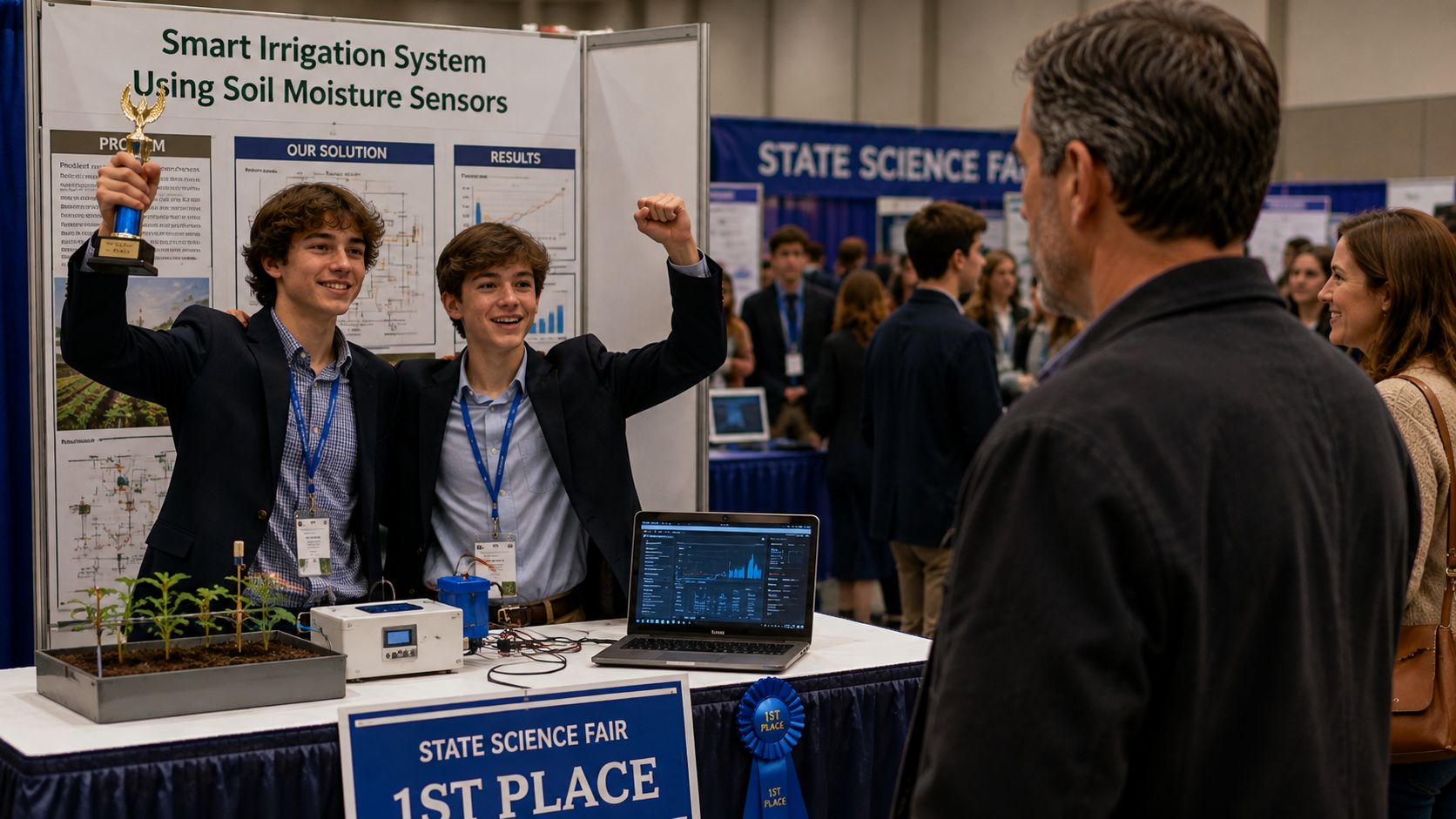
For twelve years, Mara had learned not to expect anything from the man who had once promised to build a family with her.
Not a phone call.
Not a birthday visit.
Not even a message asking how the boys were doing.
So when she walked into the crowded convention center for the statewide science fair and saw him standing less than thirty feet away, she stopped.
Daniel looked different.
Older. More polished.
He wore a dark jacket and stood beside a woman Mara had never met and a teenage boy who looked about the same age as her sons.
For a moment, neither of them moved.
Then Daniel recognized her.
His expression changed immediately.
“Mara?â€
She gave a small nod.
Behind her, sixteen-year-old brothers Noah and Lucas were carrying a large display board toward the competition area.
Daniel looked at them.
Then back at her.
“Those are…â€
“Yes,†Mara said.
“Those are your sons.â€
He had left before they could remember much about him
When Noah and Lucas were four years old, Daniel left.
There had been months of arguments before that.
Money was tight. Daniel traveled constantly for work, and eventually he told Mara he wasn't ready for the kind of life they had built.
Mara remembered staring at him across the kitchen table while two little boys slept upstairs.
“You're already living that life,†she told him.
But within weeks, Daniel was gone.
At first there were phone calls.
Then fewer calls.
Birthday cards arrived for a couple of years.
Eventually even those stopped.
Mara stopped explaining his absence.
She simply raised the boys.
Life continued without him
There were no dramatic breakthroughs.
There were school lunches, dentist appointments, broken bicycles, late-night fevers and parent-teacher meetings.
Noah developed a fascination with electronics.
He collected broken radios and old computer parts from yard sales and tried to make them work again.
Lucas loved environmental science.
He kept notebooks filled with drawings of irrigation systems, solar panels and tiny machines he thought might help farmers use less water.
Their apartment wasn't large, and there was no workshop.
So the kitchen table became one.
Mara sometimes woke up at midnight and found wires, screwdrivers and pieces of cardboard spread across it.
She complained.
Then she made them sandwiches.
One teacher noticed what they could do
During their first year of high school, their science teacher, Mr. Bennett, noticed that the brothers approached problems differently.
Noah could build almost anything.
Lucas could explain exactly why it mattered.
Together, they started working on a low-cost system designed to measure soil moisture and automatically control small amounts of water.
The idea wasn't glamorous.
But it worked.
They built most of the prototype from inexpensive parts and recycled materials.
Their school entered it into a regional science competition.
They won.
Then they qualified for the state event.
For Mara, that alone felt enormous.
She took the day off work.
She packed snacks.
She took too many photographs.
And she had absolutely no idea Daniel would be there.
Daniel had built another life
Years after leaving, Daniel had remarried.
His wife, Rebecca, worked in healthcare administration.
Their son, Ethan, was fifteen.
Ethan attended a private school known for its science and technology program.
He had qualified for the same competition with a robotics project.
That was why Daniel was standing in the convention center.
Not because he had come looking for Noah and Lucas.
He didn't even know they would be there.
“You never told me they were doing things like this,†Daniel said quietly.
Mara looked at him.
“You never asked.â€
Daniel didn't answer.
The boys knew exactly who he was
Noah noticed the conversation first.
“Mom?â€
Mara turned.
Both boys were looking at Daniel.
They knew his face from old photographs.
Mara had never hidden who their father was.
Daniel took a step toward them.
“I'm Daniel.â€
Lucas gave a short nod.
“We know.â€
Daniel looked as though he had prepared for anger.
Instead, the boys were simply polite.
That seemed harder for him.
He asked about their project.
Noah explained the sensor system.
Lucas explained how inexpensive versions could potentially help small gardens and farms avoid wasting water.
Daniel listened.
Then an announcement called competitors to their assigned areas.
“We have to go,†Noah said.
And they walked away.
Then the names were announced
The competition lasted several hours.
Judges moved from project to project.
Students answered questions.
Families waited.
Ethan performed well.
So did dozens of other students.
Daniel occasionally glanced toward the far side of the room where Noah and Lucas stood beside their display.
At the end of the day, everyone gathered near the main stage.
Awards were announced category by category.
When the environmental innovation category was called, Mara grabbed both boys' hands.
Third place was announced.
Then second.
Then the presenter opened the final envelope.
“First place goes to Noah and Lucas Carter.â€
For a second, neither brother moved.
Then Mr. Bennett shouted from behind them.
Mara laughed.
The boys walked onto the stage together.
Daniel stood several rows away.
Watching.
The medal wasn't the part that hurt
After the ceremony, Daniel approached them again.
This time he looked different.
Less confident.
“I don't really know what to say,†he admitted.
Noah adjusted the medal hanging around his neck.
Lucas waited.
Finally Daniel said:
“I'm proud of you.â€
There was a pause.
Then Noah answered.
“Mom should be.â€
Daniel looked toward Mara.
Noah continued.
“She was there when this thing didn't work.â€
Lucas smiled.
“Which was most of the time.â€
They laughed.
Daniel didn't.
Not because the comment was cruel.
Because it was true.
Daniel had arrived for the finished project.
Mara had been there for every failed version.
Ethan surprised everyone
Before Daniel could say anything else, Ethan walked over.
He had been standing nearby.
“Your water sensor was actually really good,†he told the twins.
Lucas looked at him.
“Your robot almost knocked over a judge.â€
Ethan laughed.
“Yeah. We're pretending that didn't happen.â€
Within minutes, the three boys were talking about sensors, programming and motors.
Mara watched them.
Whatever mistakes the adults had made belonged to the adults.
The boys didn't have to inherit them.
Daniel called three days later
He didn't ask Mara to forgive him.
He didn't make a dramatic speech.
Instead, he said something she hadn't expected.
“I searched their names.â€
Mara stayed quiet.
“I found their regional competition. Their school newsletter. Noah's electronics club. Lucas's environmental project.â€
Another pause.
“All of it was there.â€
“Yes.â€
“I could have known.â€
“Yes.â€
That was the part Daniel seemed to struggle with most.
Nobody had prevented him from knowing his sons.
He had simply stopped looking.
Mara gave him one rule
Daniel asked whether he could see the boys again.
Mara didn't answer for them.
“They're old enough to decide that themselves.â€
“I understand.â€
“But if they say yes, don't arrive with promises.â€
Daniel stayed silent.
“Don't tell them you're going to make up for twelve years. You can't.â€
“What do I do?â€
“Show up once.â€
“And then?â€
“If they invite you again, show up again.â€
There was no perfect ending
A month later, Daniel attended a small school technology exhibition.
No expensive gift.
No photographer.
No big apology.
He stood beside Noah while the boy explained a circuit board.
Later, Lucas showed him a redesigned version of the irrigation system.
The conversation was awkward.
But Daniel stayed until the end.
Whether the relationship would become something meaningful was impossible to know.
Trust wasn't created because two teenagers won an award.
And a medal couldn't erase twelve years.
But it could create a moment when someone finally saw what had been growing without them.
Mara kept the photograph from that day.
Not the one of the boys holding their medals.
Her favorite was taken later.
Noah was eating pizza.
Lucas was complaining that his medal ribbon was uncomfortable.
Mr. Bennett was laughing in the background.
They weren't winners in that photograph.
They were simply her boys.
And they had been enough long before anyone called their names from a stage.