For eight years, I arranged my life around my father-in-law.
I cooked his meals.
I drove him to appointments.
I learned which medications had to be taken with food and which ones made him sleepy.
When he stopped being able to walk safely on his own, I was the one who woke up at night when I heard him moving down the hallway.
I never expected anything in return.
He was family.
At least, that was what I believed.
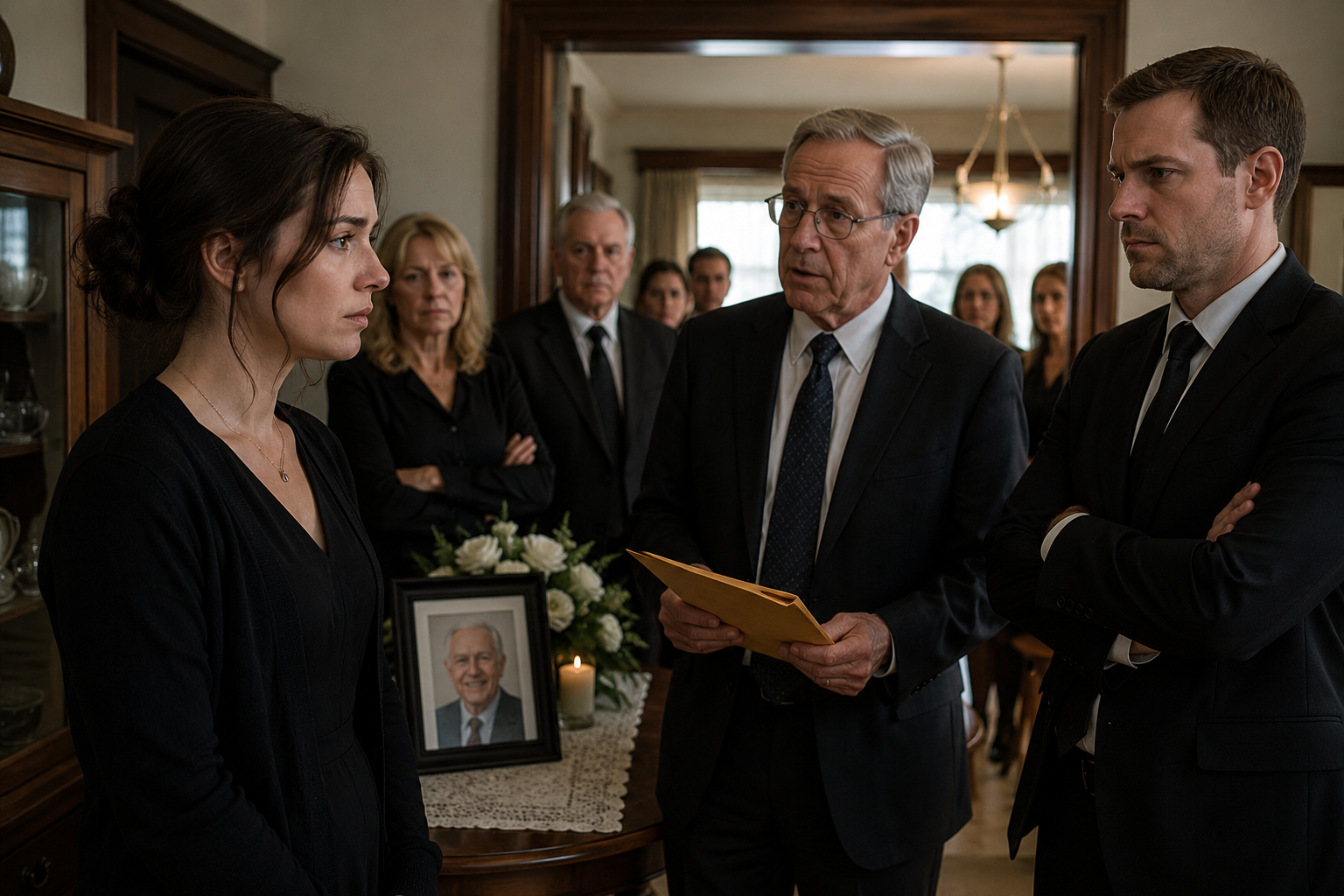
Then, less than an hour after his funeral, my husband pulled me aside and said six words that made those eight years feel like they had disappeared.
“I need you to pack your things.”
I thought grief had made me misunderstand him.
It hadn't.
And before I could even ask what would happen to me, my father-in-law's lawyer walked into the room.
He closed the door behind him.
Then he looked at my husband and said:
“Before anyone leaves, everyone needs to sit down.”
Eight years earlier
When I married Michael, his father Thomas was one of the first people who made me feel as though I truly belonged in the family.
Thomas had spent most of his life working with his hands.
He could repair almost anything, hated throwing useful things away, and kept a garage filled with coffee cans containing screws he insisted he might need someday.
He was stubborn, funny and fiercely independent.
Then his health began to change.
At first, it was little things.
He forgot appointments.
He stopped driving at night.
He began having trouble with the stairs in his house.
Michael and I lived only fifteen minutes away, so we started visiting more often.
Eventually, Thomas needed someone checking on him every day.
Michael had recently taken on more responsibility at work.
I was working too, but my schedule was more flexible.
So gradually, without any single conversation where we officially decided it, I became the person Thomas depended on.
“You're better at this than I am”
I picked up his prescriptions.
I made dinner.
I drove him to appointments.
I cleaned the house.
And when doctors eventually told us he should no longer live alone, Thomas moved into our spare bedroom.
Michael promised it wouldn't all fall on me.
For a while, it didn't.
But slowly, things changed.
Michael started coming home later.
Whenever Thomas had an appointment, something seemed to come up at work.
Whenever his father needed help during the night, Michael somehow slept through it.
“You're better at this stuff than I am,” he told me once.
I laughed at the time.
I shouldn't have.
My career slowly disappeared
Months became years.
My work hours became harder to maintain, so I reduced them.
Then I left my job entirely.
Michael told me we were fortunate that his salary could support us.
“We're a team,” he said.
And I believed him.
Thomas hated that I had given up so much.
One afternoon, while I was helping him button his shirt before an appointment, he caught my hand.
“You had plans before all this,” he said.
“I still have plans.”
“No,” he replied. “You have responsibilities.”
I tried to laugh.
Thomas didn't.
“You shouldn't confuse the two.”
I remembered that conversation for years.
Thomas saw more than we realized
As his health declined, Thomas and I spent countless quiet hours together.
We watched old westerns.
We sat on the porch when the weather was warm.
Sometimes he talked about Michael.
Not the man Michael had become.
The boy he had raised.
“He always wanted the next thing,” Thomas told me once.
“Next job. Next car. Next house.”
I smiled.
“Ambition isn't bad.”
Thomas looked toward the driveway.
“No. But forgetting who helped you get somewhere is.”
I didn't know then that he wasn't talking only about himself.
My marriage became quieter
Michael and I stopped arguing long before I realized that silence could be worse.
We barely ate together.
He spent more weekends away.
There was always a conference, a client dinner, or a project that required him somewhere else.
I told myself he was working hard.
I told myself caring for an ill parent affected everyone differently.
I told myself that once Thomas no longer needed me, Michael and I would find each other again.
Thomas seemed less convinced.
One evening, after Michael had left for what he called a last-minute work dinner, Thomas looked at me.
“Do you know where he is?”
“Dinner.”
“That's not what I asked.”
I felt defensive immediately.
Thomas changed the subject.
But I never forgot the question.
Then Thomas asked me to drive him somewhere unusual
About a year before he died, Thomas asked me to drive him downtown.
“Doctor?”
“No.”
“Bank?”
“No.”
He handed me a piece of paper with an address.
It belonged to a law office.
“Do you need me to come inside?”
“Absolutely not.”
Thomas smiled.
“You'll ruin the surprise.”
I assumed he meant birthday paperwork, estate planning, or some other ordinary legal matter.
I waited in the car for almost two hours.
When Thomas came back, he looked exhausted.
But strangely satisfied.
“Everything okay?”
“For the first time in a while,” he said, “I think it will be.”
His final weeks were difficult
Thomas declined quickly during his final winter.
Eventually, he spent most of his days in bed.
I slept lightly because I was afraid I wouldn't hear him call.
Michael spent increasingly little time at home.
Sometimes Thomas asked where he was.
I stopped making excuses.
“Working,” I would say.
Thomas always gave me the same sad look.
Three nights before he died, he asked me to sit beside him.
His voice was weak.
“Promise me something.”
“Anything.”
“When this is over, don't let anybody tell you those years belonged to me.”
I frowned.
“What does that mean?”
“They were your years.”
He squeezed my hand.
“Make sure you get some of them back.”
Thomas died early on a Thursday morning
I was beside him.
Michael wasn't.
I called my husband four times before he answered.
His voice sounded irritated.
Then I told him.
He became silent.
“I'll come home.”
He arrived almost three hours later.
I expected him to break down.
Instead, he immediately began discussing arrangements.
Funeral home.
Cemetery.
Calls to relatives.
It felt efficient.
Almost too efficient.
The funeral ended just after noon
I remember almost nothing about the service.
People hugged me.
Someone told me Thomas had always spoken highly of me.
Another person said I had been a wonderful daughter to him.
Every time someone said it, I felt myself getting closer to tears.
Afterward, several relatives gathered at Thomas's house.
I was in the kitchen, automatically arranging plates of food, when Michael walked in.
“Can we talk?”
I followed him into Thomas's old office.
Michael shut the door.
He didn't sit.
“I need you to pack your things.”
I stared at him.
“What?”
“Our marriage has been over for years.”
My stomach dropped.
“You're telling me this today?”
“There was never a good time.”
I almost laughed.
“So you chose your father's funeral?”
He looked annoyed instead of ashamed.
“I don't want this to become ugly.”
Then he said the sentence that finally made everything clear.
“The house will need to be sold, and I need to start sorting out Dad's estate.”
Not our grief.
Not our marriage.
The estate.
Then the lawyer appeared
There was a knock before I could respond.
The door opened.
A man in his late sixties stood there carrying a leather folder.
I recognized him.
He was the lawyer Thomas had asked me to drive him to see.
“Mrs. Hayes,” he said to me.
Then he looked at Michael.
“I was hoping to catch everyone before they left.”
Michael frowned.
“Can this wait?”
The lawyer shook his head.
“Your father was very specific.”
He stepped into the room.
“Before anyone leaves, everyone needs to sit down.”
Thomas had changed his estate plan
Michael's sister, Rebecca, and his older brother, James, were called into the room.
I tried to excuse myself.
“I'm not family anymore, apparently.”
The lawyer looked directly at me.
“You're the reason we're here.”
Michael's face changed.
The lawyer opened his folder.
Thomas had updated his will eleven months earlier.
He had been evaluated by his physician first to document that he was mentally capable of making his own decisions.
Most of his personal savings had been divided equally among his three children.
But the house was different.
Thomas had left it to me.
Michael stood up.
“That's ridiculous.”
The lawyer continued.
Thomas had also created a separate account containing money from the sale of a small rental property.
That account was also mine.
I couldn't speak.
Then the lawyer handed me a letter
It was written in Thomas's uneven handwriting.
The first line made me cry immediately.
“Anna, if you're reading this, then you stayed until the end.”
I covered my mouth.
The room became completely silent.
Thomas wrote that he had watched me give up work, friendships and years of independence while his son slowly withdrew from the family.
He wrote that he had repeatedly encouraged Michael to take more responsibility.
Michael hadn't.
Then came the sentence that made Michael turn pale.
“I also know why my son has been away so often.”
Thomas knew about another woman
I looked at Michael.
He didn't look back.
Thomas hadn't hired anyone to follow him.
He hadn't needed to.
Michael had been careless.
Several months earlier, Thomas had accidentally seen a message appear on Michael's phone while it was charging beside his bed.
Later, Michael's sister Rebecca confirmed that she already knew there was someone else.
She had confronted him privately.
He told her he planned to leave me after Thomas died.
“You knew?” I asked.
Rebecca began crying.
“Dad made me promise not to tell you. He said he needed time to protect you first.”
I looked down at the letter.
Suddenly, that mysterious trip to the lawyer's office made sense.
Michael had expected to inherit the house
That was why he wanted me gone so quickly.
He believed Thomas's house would become part of his inheritance.
He had already been making plans.
The lawyer explained that Thomas had become concerned after learning Michael intended to end the marriage immediately after his death.
Thomas wanted to make sure that the person who had spent eight years caring for him was not left with nothing.
Michael started arguing.
He said his father had been manipulated.
He said the will couldn't possibly stand.
The lawyer remained calm.
“Your father anticipated that response.”
Thomas had taken every reasonable step to document that the decision was his.
Michael looked at me as though I had somehow done this to him.
I hadn't even known.
I finally understood Thomas's last words
Don't let anybody tell you those years belonged to me.
They were your years.
Make sure you get some of them back.
Thomas hadn't been apologizing.
He had been telling me what he had already decided.
The house wasn't payment for caring for him.
He made that clear in the letter.
It was a place where I could begin again.
The money wasn't a reward.
It was breathing room.
Time to decide what I wanted next.
I did pack my things
Just not the way Michael expected.
I returned to the house we had shared and packed everything that belonged to me.
Michael stayed at a hotel.
I hired my own attorney.
I didn't scream at him.
I didn't beg him to stay.
By then, I understood that our marriage had ended long before he finally said the words.
What hurt most wasn't that he wanted a divorce.
It was realizing how long he had allowed me to continue sacrificing for his family while quietly planning a life without me.
Six months later, I went back to work
Not at the same company.
Too much time had passed.
I enrolled in a short professional course first.
Then I contacted an old colleague.
I was terrified before I called her.
She answered on the second ring.
“Anna?”
“Hi.”
There was a pause.
Then she laughed.
“I thought you'd disappeared.”
In a way, I had.
But I wasn't gone anymore.
Thomas's house slowly became mine
At first, everything reminded me of him.
His chair.
His coffee mug.
The ridiculous collection of screws in the garage.
I couldn't bring myself to change much.
Then one Saturday, I painted the spare bedroom.
A month later, I turned it into an office.
I kept Thomas's old toolbox on a shelf.
Not because I needed it.
Because I liked remembering the man who had noticed what everyone else had taken for granted.
The last note was hidden in his desk
I found it almost a year later.
It was folded inside an envelope with only my first name written across the front.
There were only four lines.
“You were never invisible here.
I saw every late night.
Every appointment.
Every time you stayed.”
I sat at his desk and cried harder than I had at the funeral.
For years, I thought caring for Thomas had taken my life away from me.
In the end, he was the person who reminded me that I was still allowed to have one.